Máster Universitario en Dirección de Procesos Estratégicos

Máster Universitario en BPM para la Transformación Digital

Mostrando entradas con la etiqueta Process Improvement. Mostrar todas las entradas

martes, 17 de enero de 2023

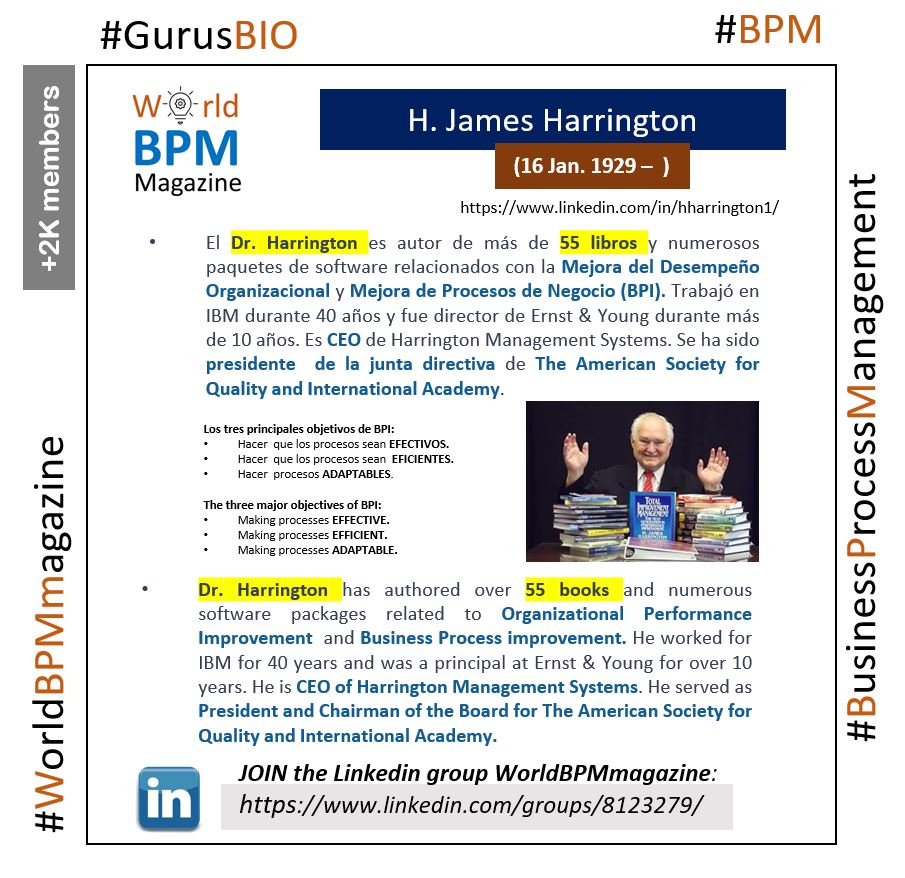
#GuruBIO: H. JAMES HARRINGTON: Autor de más de 55 libros sobre Business Process Improvement, Gestión del Cambio e Innovación de Procesos

Dr. H. James Harrington (nació el 16 enero de 1929)  es autor de más de 55 libros y numerosos paquetes de software relacionados con la Mejora del Desempeño Organizacional y Mejora de Procesos de Negocio (BPI). Trabajó en IBM durante 40 años y fue director de Ernst & Young durante más de 10 años. Es CEO de Harrington Management Systems. Se ha sido presidente de la junta directiva de The American Society for Quality and International Academy. Ha sido galardonado con múltiples distinciones en la profesión de la Calidad. Más información sobre su  biografía.

LIBROS (Extensa bibliografía)

El Dr. Harrington es un destacado autor sobre BPM, la innovación, la calidad y la mejora de procesos. Ha escrito más de 55 libros sobre estos temas, entre ellos, destaco los libros que he estudiado a fondo:
  • "Process Management Excellence: The Art of Excelling in Process Management (Five Pillars of Organizational Excellence)"  "Excelencia en la Gestión de Procesos: El arte de la Excelencia en la Gestión de Procesos - 5 Pilares de Excelencia Organizacional" (2006): en este libro,  proporciona un marco integral para lograr la excelencia en la gestión de procesos en las organizaciones. El libro brinda orientación práctica y herramientas para implementar su modelo de cinco pilares para la excelencia organizacional, que incluye: Gestión de Procesos, Gestión de Proyectos, Gestión del Cambio, Gestión del Conocimiento y Gestión de Recursos.
  • Streamlined Process Improvement" "Mejora de procesos optimizada" (2011): SPI es el  poderoso programa desarrollado por Harrington que  guía  cómo descubrir las últimas herramientas de proceso para realizar mejoras más rápidas y drásticas utilizando la revolucionaria metodología de mejora PASIC; usar cuestionarios paso a paso y listas de verificación para agilizar su trabajo, lo que resulta en un valor óptimo para las partes interesadas; utilizar las metodologías más recientes, incluidos modelos de simulación, análisis de riesgos, Five Ss, Innovación de procesos, Tecnología de la información, Lean y Six Sigma, para llevar el  negocio al siguiente nivel; y aumentar la innovación: para impulsar el crecimiento y los beneficios durante muchos años.
  • "Business Process Improvement: The Breakthrough Strategy for Total Quality, Productivity, and Competitiveness"  "Mejora de procesos de negocio: la estrategia innovadora para la calidad total, la productividad y la competitividad" (1991: Detalla cómo aplicar las técnicas de mejora de la calidad desarrolladas originalmente para el sector manufacturero a las industrias de servicios,   brindando una fórmula paso a paso que ayuda a las empresas a mejorar la calidad y la productividad en las áreas de soporte. Aquí, en un volumen integral, se encuentra toda la información que una organización necesita para iniciar el proceso de mejora de inmediato: cómo determinar las necesidades y expectativas del cliente y brindar el mejor servicio; cómo establecer qué procesos impulsan su negocio; cómo crear equipos de mejora de procesos y capacitar a los líderes de equipo; cómo eliminar la burocracia, simplificar el proceso y reducir el tiempo de procesamiento; cómo medir el progreso y brindar retroalimentación a los participantes; cómo documentar los niveles de mejora y certificar operaciones y actividades; y cómo garantizar la mejora continua.  
  • "Simulation Modeling Methods: To Reduce Risks and Increase Performance" "Métodos de modelado de simulación: para reducir los riesgos y aumentar el rendimiento" (2000): este libro proporciona estrategias para evaluar sistemas nuevos o rediseñados antes de implementarlos, reduciendo drásticamente los costos, el tiempo de ciclo, las tasas de error, el inventario y el tiempo de inactividad. Describe los métodos de simulación de procesos utilizados para ayudar a las principales empresas a aumentar sustancialmente tanto la eficiencia como la rentabilidad de sus sistemas más importantes.  
Con su contribución y lo que queda por proporcionar, sin duda es un gran referente para todos los que nos dedicamos a la Mejora de Procesos con la disciplina BPM.

jueves, 9 de enero de 2020

Before automating a process ... improve it!


Automation has been impacting Enterprises in 2019, and the trends marks than for the next years will be more present in all businesses. The effect of Digital Transformation makes companies think or carry out automation projects. But this is not digital transformation. To be digital transformation, it has to happen that emerging technologies are applied to the business, creating new products and services, new business models and changes in the value chain. In another case, we will be talking about Digitalization, but not about Digital Transformation. But without a doubt, the processes and the quality of the data play a key role both in the digital transformation and in the digitalization of the value chain of an organization.
When companies think of Digitalization they are focusing on the digital automation of their business processes. Robotizing tasks or processes is not Digital Transformation. The great growth of RPA software companies (Robotic Process Automation), together with articles magnifying this software, is causing companies to consider automation projects for their processes. The global RPA services market will reach $ 7.7 billion next year and will grow to $ 12 billion in 2023, according to Forrester.
Institute For Robotic Process Automation defines RPA as “the application of technology that allows employees in a company to configure computer software or a “robot” to capture and interpret existing applications for processing a transaction, manipulating data, triggering responses and communicating with other digital systems”. The reality is that RPA facilitates in processes to automate repetitive tasks PREDICTABLE: Replicating activity on the desktop of the computer; consolidating data in standardized reports or formats; moving data from one database to another; etc. RPA assumes the AS-IS process and creates software bots that mimic human behavior for low-value repetitive tasks. As Forrester says, "RPA takes a tactical approach to isolate and eliminate pain from the process." In the processes from beginning to end, there will be human participation that makes decisions, so RPA will not be the automation solution.
Forrester has also investigated how automation will affect the future of work, predicting a general reduction in the U.S. workforce of 16% by 2030, given that a tenth of new businesses will start their lives with more digital workers than humans. But existing companies need to manage the restructuring of equipment and it is not so simple to carry out a transformation of this type, due in most cases to Unions or Company Committees, or the idea of certain managers not to lose the workforce to office. But companies will not be able to survive by having to compete in a digital ecosystem. The most successful companies in the world today operate with software and employ fewer employees than their predecessors.
Gartner's predictions indicate that automation continues to deliver on the promises of improved cost and higher effectiveness for the clients of infrastructure service providers, and by 2020, more than 50% of current manual operational tasks in infrastructure managed services will be replaced by intelligent automation services. And by 2021, intelligent automation will generate an additional 20% savings over what is achievable today, in application testing services for end users.
Bill Gates says“The first rule of any technology is that automation applied to an efficient operation will magnify the efficiency. The second is that automation applied to an inefficient operation will magnify the inefficiency” (Jeston, 2009)

lunes, 27 de marzo de 2017

Any Business Innovation and Transformation requieres an Enterprise Architecture


Everyone realizes that organizations have to be innovating or continually transforming themselves to be competitive in a changing world like the present one. Both Innovation (doing something different or something new) and Transformation (making changes to something that already exists: optimizing, improving ...) will involve making changes in the organization to take it from a current state to a future state with the changes implemented. Considering that "55% of the current 500 Fortune organizations will not be in the Fortune elite in 2025" according to the OECD, "86% of executives say that innovation is extremely or very important to strategy of growth of their companies, but only 19% believe they succeed with any of the components needed" according to IBM Global, and "72% of transformation programs fail to meet their real objectives" according to McKinsey, we must wonder how to carry out this process of innovation or business transformation.
In the area of business processes, you have to consider what dimension reach the innovation or transformation project, since we can talk about Process Improvement (the process works but we want it to be more efficient, effective, more optimal ...), Process Redesign (the process is not functioning as it should, correcting it by changing the flow, eliminating parts of the process, automating parts ...), Process Reengineering (fundamental revision and radical redesign of processes for dramatic improvements in critical metrics) or Paradigm Shift to a Process Oriented Company (a change in the basic assumptions that implies a major change in the culture of the organization), and its management of change, risks and impacts in the organization should be controlled and made the right decisions so as not to fail.
If we think about our home and about a possible reform by adding a bathroom, we would have to study the viability of this project, and for it, we will have to take into account that the legislation allows us to make modifications in our house (for example, to create a window outside from the new bathroom), which can be carried out (more hot water capacity, longer pipes, throwing a wall ...) when studying the plans (foundation, distribution, electrical system, plumbing system). The study will be able to make a budget and a project of realization. In the same way, companies need to study their Enterprise Architecture (an integral image of their organization and the relationships among the main assets of a company, including processes, people, products, services, applications, technology, documents, etc.) to carry out any project of business innovation or transformation, because it is required to know with the maximum certainty what, where, when, how, how much it costs, what risks it has and why to carry out that project.


domingo, 11 de septiembre de 2016

BPM CASE: New Zealand National Courier Company’s process improvement journey, delivers Reliability

New Zealand Couriers is positioned as the premier provider of network courier services to New Zealand businesses. With 46 trucks, 5 cargo planes, 22 branches and over 600 couriers their overnight delivery covers 99.9% of NZ, with business delivery in the main centres by 9:30am the next working day. They also provide over 1,000 same day local and regional services and a comprehensive, cost-effective international freight service.
Promapp has been a key enabler in the documentation, sharing and continuous improvement of their processes for the benefit of their customers, people, partners and suppliers.With Promapp, the New Zealand Couriers team can easily share their processes with customers and business partners, identify and meet compliance requirements with key legislation and identify complex processes to facilitate better understanding and implementation. 

Promapp provides a central place to store our processes, so we can make sure we’re all sticking to the best practices we’ve perfected over the past 50 years,” says Dianne Van Aken, their National Training Coordinator.

New Zealand Couriers has more than 500 processes in Promapp and there have been more than 90,000 process views since they began their Promapp journey.

With more and more Freightways Group companies coming on board, Promapp will soon be managing the processes of 5 key business units.


Watch the Video Case Study to learn more about New Zealand Courier’s process improvement journey.


Source: Promapp